Own Where You Are. Especially If You’re Not Where You Want to Be.
I remember the time vividly. The time and the pain. After almost 10 successful years as a corporate lawyer, I was ready for a change and purchased a franchised painting business. The prior owners had started it less than two years earlier, and my goal was to grow and scale aggressively. In my first year, I seemed to be doing just that. Revenue was up 50% over the prior year, I had already hired an ops/admin staff member, and we had more leads than I could handle as the only person in the business doing estimating and sales. I was well on my way to winning an award at the national conference. And I wasn’t where I wanted to be.
I wanted to scale the business. I wanted to add a salesperson so I didn’t have to do all the estimating. I wanted to make a leap that most franchisees in the system hadn’t been able to make yet, because I wanted to be one of the best. I also needed that leap to replace the income I left behind as a successful corporate lawyer. And despite the revenue growth in my first year, my income from the business was nowhere near that point.
After talking things through with a few people, I decided to hire a salesperson at the end of that first year. It was the logical next step toward growing. Only the first hire didn't go as planned. He didn’t get up to speed as quickly as I had — naively — hoped, and his presence wasn’t producing growth or added profitability in the business. When he received a great offer to go back to his former employer with a promotion, we mutually agreed to part ways.
At a peer group business retreat shortly after that, one of my fellow franchisees gave me some direct and harsh advice: I needed to learn how to run my business profitably before I scaled. And I also needed to take some time off with the upcoming birth of our second child. Both messages were hard to swallow. I wanted to grow. Now.
I only listened to part of the advice. Yes I took a couple of weeks off when our second child was born (and was very glad I did), but I plowed ahead with hiring a salesperson before I took that time off. What was there to lose? I thought I could get the new hire through training and have him out selling paint jobs while I was trying to be an attentive father and husband. Only that didn't work out, either, and it ended up costing me a lot of money. At the end of year 2, revenues were down 10% from year 1, and I felt even farther from my goals than I did after year 1.
I switched peer groups at the end of year 2 hoping that a new group with some of the largest, most successful franchisees in the system would have the insights to help me scale my business more quickly. At the first meeting with the new group, hearing the same advice felt like a gut punch. Figure out how to run your business profitably before you start scaling it. This time, I decided to take the advice. Year 3 revenues bounced back to the level of year 1, and profits had more than doubled.
In retrospect, there were multiple realities of my situation in that first year that I hadn't acknowledged:
I wasn't ready to start growing a team when I didn't understand the business well enough to hire, train and lead new people.
My lack of previous experience hiring and managing people meant that I needed to develop some new skills before I could take that on with a reasonable chance of success.
When you buy a franchise, you’re buying a system and resources to help you run the business. This franchisor had not yet developed the systems and resources to add sales people to the business profitably. The franchisees that had succeeded in doing that were the exception, not the rule. Most of the franchisees that had tried up to that point ended up financially worse off than they were before expanding. And that was exactly where I was headed.
By the time year 4 rolled around, I had figured out how to run the business profitably, the franchisor had developed systems and resources to support franchisees adding that role to their businesses, and I was able to add a salesperson to my business successfully. I was finally on my way. I was also licking my wounds, because my failure to acknowledge the realities of where I was cost me a couple of years and a sizable amount of lost profits.
As I’ve come to learn, I’m far from alone in having fallen into this trap. Here are a few examples that I’ve come across in my consulting work:
Projecting you’re further along than you are. The founder of a startup was talking about closing their current investment round — which they're calling a Series A — and starting their Series B. But they haven't sold a single product yet. Companies are typically expected to have a product in market that is gaining traction by the time they raise a Series A. Series B is for aggressive growth after a company has demonstrated real traction in the marketplace with actual product sales. Opening a Series B round before having any sales could lead to lots of uncomfortable questions, erode investor trust in the startup, and risk losing whatever momentum the startup had gained in fundraising thus far.
Ignoring your own data. A tech startup wants to grow their user base, but hasn't yet acknowledged that more than 75% of their pilot users aren't using the platform regularly. That's not a minor detail. Low usage among pilot users is a significant signal that those users don't believe they're deriving meaningful value from your service. Growing the user base before understanding and addressing that signal is building on a shaky foundation, and it can be very damaging to the reputation of a young brand.
When the proof isn’t in the pudding. A startup wants to claim that their app improves customer outcomes and reduces costs by specific amounts. The problem: the data supporting those claims comes from a university study where services were delivered in person, not through an app platform (much less that particular app). The jump from in-person to app-based service delivery is not a small one, particularly in that industry. Using that university study as validation — without acknowledging the gap — can undermine credibility with both prospective early adopters and prospective investors.
I totally get it, because I’ve been there. It makes sense to stay focused on where you’re trying to go. It also makes sense to want to project confidence to internal teams and the outside world, even if you don’t quite see this as “faking it ‘til you make it.” Acknowledging current challenges and limitations can seem discouraging. It can also trigger embarrassment and shame.
But that reluctance to acknowledge the current reality carries real costs. Erosion of trust with customers, investors and team members who can see the gap between the narrative and reality. Time, energy and money spent chasing the wrong questions or the wrong answers.
The good news is it doesn’t have to be that way. Consider these alternatives to the three examples I mentioned:
The founder who wants to start a Series B when they’re not really at Series A yet still has a great story to tell. The addressable market for the product is huge, and recent documented interest from a major player is a great sign that traction will come as soon as the product is commercialized and ready to sell. That story is even more compelling when investors aren’t expecting to hear a Series B story.
The startup ignoring their own data has the opportunity to create a great customer experience by engaging more closely with their pilot clients to better understand their needs and how the platform addresses those needs. That process would make the product better, create raving fans instead of disinterested guinea pigs among the pilot users, and provide a much more compelling product to attract and retain new customers.
The startup trying to use the university study to prove the app’s effectiveness can reframe the messaging to emphasize the expected benefits of the app (rather than actual benefits). That message carries a lot more credibility with prospective pilot users and investors. Once there’s enough data from users of the app to validate the actual results, if those results are consistent with the university study, the startup will be off to the races. And if not, the startup will know what it needs to work on.
Owning where you are isn't defeat or a sign of weakness. It's essential for getting to where you want to go. Once I finally acknowledged the realities of my situation with the painting business, I was able to build a foundation that made real growth possible. Building that foundation became possible the moment I stopped pretending I was somewhere I wasn't.
So wherever you are right now — own it. It's the only place you can move forward from.
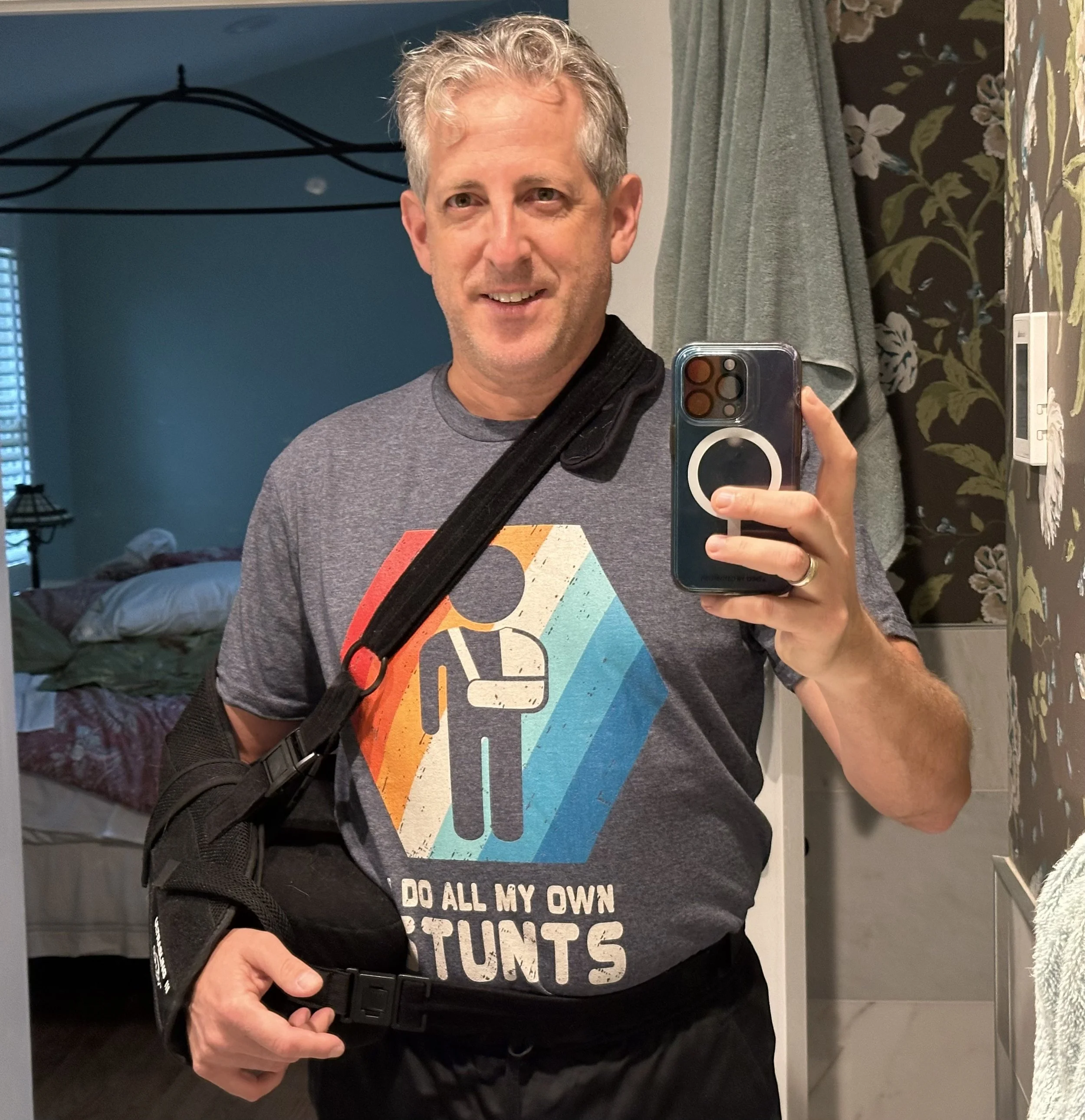
Oh…and that picture? I took that one right after major shoulder surgery. I tore just about everything while playing tennis, and let’s just say I wasn’t thrilled at facing over a year of rehab to get back to my normal slate of activities.
I owned it, though. I leaned into my rehab, learned to play tennis lefty while my right shoulder was recovering (that was an eye-opener), and ended up rebuilding my right-handed tennis game to be better than it was before the injury.
All because I owned where I was as much as I owned where I wanted to be.